Charles Bivins was a notorious presence on the Los Angeles poetry scene for nearly thirty years. Those who knew him intimately and befriended him also feared him. Most of us considered him a genius poet. But we also knew how vicious he could become in the fame-seeking world of poetry politics. Demanding his due, he often spitefully played one poet off another. He led a sedentary life using the telephone as his weapon of choice to defame other poets. Sometimes he attacked a poet directly with outright harassment and ridicule. Charles often began his poetry readings with a diatribe, and he once told me he admired Artaud's theatrical project in which, as Charles claimed, the curtain rose to reveal a machine gun aimed at the audience. He was a literary monster. A nasty alcoholic. No niceties about it. Even though he was probably disguising his own personal fears and shortcomings by attacking others, he revealed his contempt for others who did not acknowledge his genius. Who would love him anyway?
At one time he and I ended our relationship, vilely cursing each other. Years later Charles discovered he had diabetes and had to stop drinking. He called to apologize and explained that the chemical imbalances in his body had made him mean. At first I refused to talk with him, but eventually I realized he was trying his best to act as a decent human being. By then he had alienated most of the people he knew, especially the ones who had treated him kindly. I agreed to take him grocery shopping once a month. He always talked poetry in the little time we spent together. His favorite poet was Walt Whitman and he would bring a passage to read to me. He had a prodigious memory and could recite poets and writers by heart. I loved hearing his recitations of Dylan Thomas' poems. Charles's poetry had developed out of the modernist tradition, having read all of James Joyce and T. S. Eliot. At the end of his life he was reading Eliot's Four Quartets, which he claimed were the final resolution of the poet's body of work. He was also close to the Beat generation in his passions and had spent some of his young years in San Francisco. He identified with Ginsberg, but it was Gary Snyder's work that seems to be reflected in Charles's prosody.
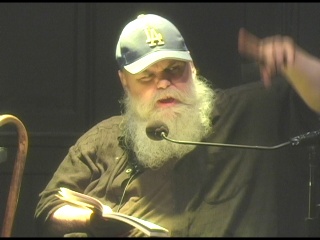
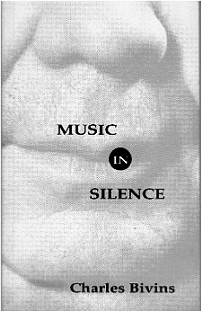
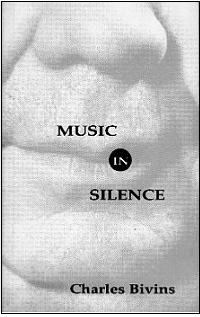
Charles was one of the first poets I met in Los Angeles when I arrived in 1985. After hearing him read at an open reading at Bebop Records in Reseda that summer, we began our long friendship. I was honored to publish his one book of poetry, Music in Silence, almost a decade later. One of the highlights of his last years was his reading with Heat Press poets at Beyond Baroque Literary / Arts Center. He had always wanted to perform his poetry with the poet/saxophonist Elliott Levin who joined him along with keyboardist Don Preston.
He hadn't quite quelled his bitterness but he had become a bit more even-tempered, a remarkable feat for this raging poet, revealing a certain wisdom he had gained through his reading Lao Tzu's Tao Te Ching. He was a poet with no other job or means of self-support. His physical disability, and that of his brother Patrick, left them dependent on the state for the barest necessities of survival. There were times when he was unable to go shopping, and from time to time he was hospitalized with various maladies. Late last year after being diagnosed with cancer, he was given false hope by doctors who must have realized that the cancer was inoperable and his body was beyond repair. Nevertheless, he was back to writing poetry and claimed it was one of the most prolifically creative periods in his life. Doctors who had promised him a chance to survive finally admitted to him there was no hope. After collapsing on February 1st, Charles was brought to Valley Presbyterian Hospital to receive the news that he would not survive the cancer. At his bedside were copies of Four Quartets and an old battered paperback edition of Oscar Williams' anthology, Immortal Poems of the English Language. He asked me to read Poe's "Annabelle Lee" to him as he drifted in and out of morphine sleep. When I left him that Sunday afternoon I shook his hand and kissed his forehead. I noticed two blue tablets in which he wrote his final poetry; one very exquisite poem he had read to me over the phone days before that spoke of pathways into the light. Unmistakably a meditation on his own passing.
Charles Bivins died on February 11th ---the Feast of Saint Caedmon, an illiterate Anglo-Saxon monk of the 7th century, who is considered to be the first English vernacular poet. When I attempted to retrieve Charles's belongings the following weekend, no one could tell me what had happened to either his books or the tablets-perhaps containing the prolific outpouring of the final revised version of his masterwork collection, Savage Rose. The hospital admitted that in all probability, his papers were disposed of, according to policy, as the patient's possible infectious remains. Charles believed that all poetry, in one way or another, was political. And that the role of the poet was not respected in our society. Charles was a pariah. In his case, society took the poet's final words and destroyed them, a disgraceful act of neglect and ultimate insult that would have made the mad poet of San Fernando Valley curse the heavens. PLA
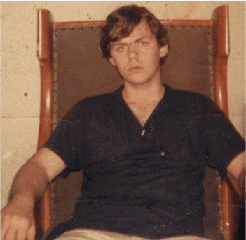
In 1968, in a basement room of the Hotel Paul, San Francisco.
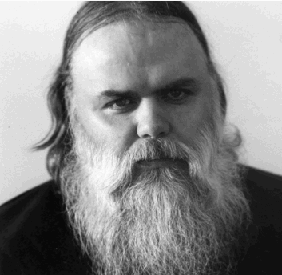
In 1993, when Music in Silences was published.
For information on obtaining Music In Silence, write to:
Heat Press
P.O. Box 26218
Los Angeles, CA 90026-0218